Beginners6 min read
Big vs Small BJJ Gym: Which Is Better for a Beginner?
Compare big and small BJJ gyms by the classes you can attend, coaching access and partner options. Includes a usable-class worksheet and a worked example.
BJJ practitioner with 8 years of experience (author-reported).
Short answer
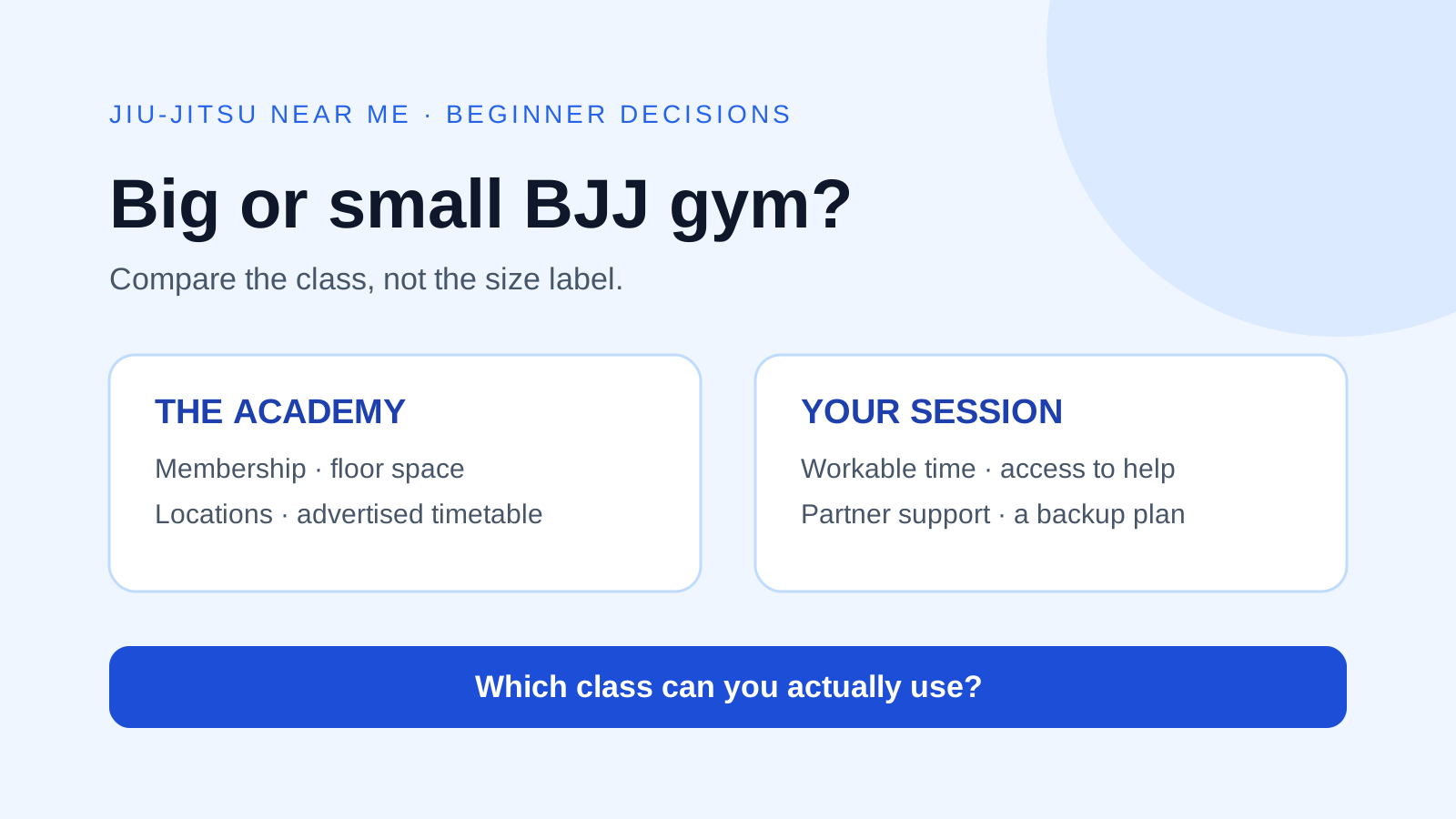
Neither a big nor a small BJJ gym is automatically better for a beginner. Compare the actual sessions you would attend: whether newcomers can join, whether you can get help, how partners are organized and whether the timetable fits your life. A large academy can still run a small beginner class, while a small academy can have a crowded evening session. Choose the workable class, not the size label.
Scope: Adults comparing recreational BJJ classes before joining. This is a practical fit comparison, not a ranking of academies, an injury-risk assessment, medical advice, child-safeguarding guidance or membership-contract advice.
Compare class size, not just academy size
When someone calls a BJJ gym big, do they mean its membership, floor space, number of locations or the class they attended? Those descriptions answer different questions. None tells you how much instruction you will receive on the evening you can train.
Ask about the specific class you would join. Note who teaches it, whether another instructor assists and how a newcomer gets help during partner work. You do not need an academy's private membership list. A conversation and an agreed trial visit can answer the narrower question: does this session work for you?
This guide focuses on size-related trade-offs and timetable fit. The broader gym-selection guide covers other enrollment questions; our red-and-green-flags guide helps you assess what happens during the visit.
What a bigger or smaller gym might offer
The possibilities below are things to test, not findings that large and small academies consistently behave differently. A gym can have a roomy facility and limited beginner hours, or a modest room with well-organized instruction.
| Dimension | Possible appeal | What to check instead of assuming |
|---|---|---|
| Coaching access | A smaller class might make it easier to ask for feedback. A larger class might have assistants. | Who watches your practice, and how do you get a question answered? |
| Timetable | A longer schedule might offer backup sessions. A shorter schedule might already fit your week. | Which classes welcome a new student and are actually reachable? |
| Training partners | A larger class might offer more possible partners. A smaller group might offer familiar partners. | Who helps you find a suitable partner for that activity if your usual partner is absent? |
| Beginner instruction | A separate beginner group might offer a clear starting point. A mixed-level class might adapt activities for newcomers. | What would you do in your first session, and who explains the unfamiliar parts? |
| Facilities | A dedicated venue might have amenities you value. A shared venue might meet your needs without them. | What space and changing arrangements are available during your actual session? |
| Social fit | You might prefer a familiar group or more people to meet. | Do you feel included without pressure to socialize beyond what you want? |
Neither more students nor fewer students guarantees individual attention. Similarly, a long list of names on a coaching page does not establish who will teach your session. Ask who is normally there and who covers absences. Treat an unanswered question as unknown, not as proof that a gym is good or bad.
Filter the timetable before comparing it
Class names are not interchangeable between academies. Art of Jiu Jitsu's trial page recommends its Basics program for people with less than a year of experience and presents Fundamentals as a later program. Jiu Jitsu Foundation's adult timetable labels Fundamentals for new students. These are each academy's own descriptions, not evidence that either curriculum is superior. AOJ's program guidance and Jiu Jitsu Foundation's timetable.
That difference matters when you count options. Do not assume every entry called Fundamentals is open to you, or that an All Levels label explains what a first-time visitor should do. Confirm with the academy which session to book and whether the published timetable is current.
Use the worksheet below for each gym. An entry is usable only after the academy confirms you can join and you can realistically reach it. This is a planning definition, not a target training frequency or a promise that you will attend.
Your usable-class worksheet
- Write your actual availability: include travel, getting changed and the time you need to leave, not just the class start.
- List eligible sessions: ask which classes welcome someone with your experience and which activities require a separate introduction.
- Mark the workable entries: use “usual,” “backup” or “not workable.” Leave unclear entry requirements marked “unconfirmed.”
- Check a disrupted week: if work removes your usual evening, is a confirmed alternative still available?
- Add the support question: record who teaches the session you would use, how questions are handled and how partners are organized.
A full-looking timetable can still leave you without a workable class. Conversely, a limited timetable is not automatically a deal-breaker if its sessions match your availability. If neither gym works, keep looking rather than comparing amenities for classes you cannot attend.
A fictional comparison: the timetable changes the answer
Imagine Academy Oak advertises a broad schedule, but most sessions overlap with your work or are not open to brand-new students. Its confirmed beginner evening fits, but you have no usable backup. Academy Cedar advertises fewer sessions, yet both its usual evening and a weekend alternative fit your calendar. Both explain how newcomers get help.
If schedule resilience is your main concern, Cedar would deserve a closer look. That conclusion follows from the hypothetical availability, not a rule that smaller gyms are better.
Now change the facts: Cedar's evening becomes unreachable, while Oak confirms a suitable weekend beginner session. Oak may now be the workable option. The recommendation changes because your usable sessions change, not because either academy has become bigger or smaller.
Neither fictional academy represents a real business, and the example is not a report of our training experience. Replace its assumptions with answers from the gyms you are considering.
Make the trial representative
If you can arrange a trial, ask to attend the class you would normally use. A quiet introductory appointment can explain the basics without showing you a busy regular session. Ask what would be different when you return, including the instructor, class format and how newcomers join partner work.
Check eligibility before assuming a trial is free or available to everyone. AOJ, for example, limits its free trial to qualifying local residents and directs other visitors to guest passes. That is its stated policy, not a universal practice or a recommendation to buy anything. Read AOJ's trial conditions. Ask your prospective gym directly about its current arrangements.
After the visit, finish this sentence: “I prefer this class because I can attend it, I know how to get help, and I liked ___.” If your only reason is “the gym is bigger” or “the group is smaller,” your comparison is not finished. You can decline a class you do not like without proving the whole academy is unsuitable for everyone.
Limits and the next step
We have not measured the cited academies' membership, class attendance, instructor attention, facilities or outcomes, and we do not classify them as big or small. Their public pages illustrate program labels and entry conditions only. Timetables can change; verify them before visiting. The worksheet is an editorial decision aid, not a validated score, an endorsement or a safety certification.
Prepare for the visit with the first-class guide, then find nearby gyms and compare the sessions you can actually use. Choose on confirmed fit, not the size of a logo, building or social-media audience.
Sources and editorial review
Not independently expert-reviewed. This guide draws on the cited sources but has not been reviewed by an independent specialist. Research and drafting were AI-assisted.
Author background: Jeremy Doromal, BJJ practitioner with 8 years of experience (author-reported). Practitioner experience is not a medical or safeguarding qualification.
A public Reddit question about large versus small gyms informed the reader question, not the factual conclusions. We read Art of Jiu Jitsu's trial and program descriptions and Jiu Jitsu Foundation's adult timetable as primary examples of their own published class labels and entry guidance. Neither source establishes academy size, attendance, teaching outcomes or comparative quality. The comparison worksheet and fictional example are original editorial synthesis; no gym visits, interviews, class counts or tests were performed.
What this guide adds: A usable-class worksheet that separates advertised timetable entries from sessions the reader can actually join and reach, plus a fictional comparison showing how schedule resilience and access to help can change the decision.
- Book Free Trial Class
Art of Jiu Jitsu · Accessed 2026-10-26
This page recommends Basics for practitioners with less than a year of experience and describes Fundamentals as a later program; This academy restricts its free trial to qualifying local residents; other visitors are directed to guest passes
- Schedule
Jiu Jitsu Foundation · Accessed 2026-10-26
The adult timetable labels Fundamentals for new students and separately lists All Levels, Intermediate, No Gi and women's classes; Timetable entries have different days and start times, so a full class list is not the same as a reader's usable beginner schedule
Find a BJJ gym near you
Search thousands of gyms across all 50 states.
Own a gym?
Claim or add your listing - free, no account required.
JD
Jeremy Doromal
Jeremy Doromal is the creator of Jiu-Jitsu Near Me. Specialist credentials and firsthand testing are disclosed only when documented for the article.
gym-selectionbeginnersclass-sizetraining-schedule
Related Posts