
Beginners6 min read
BJJ Gym Red Flags and Green Flags: A First-Week Observation Guide
Evaluate a BJJ gym during your first week with an observation log, follow-up questions, and a way to separate preferences from behavior that needs attention.
BJJ practitioner with 8 years of experience (author-reported).
Short answer
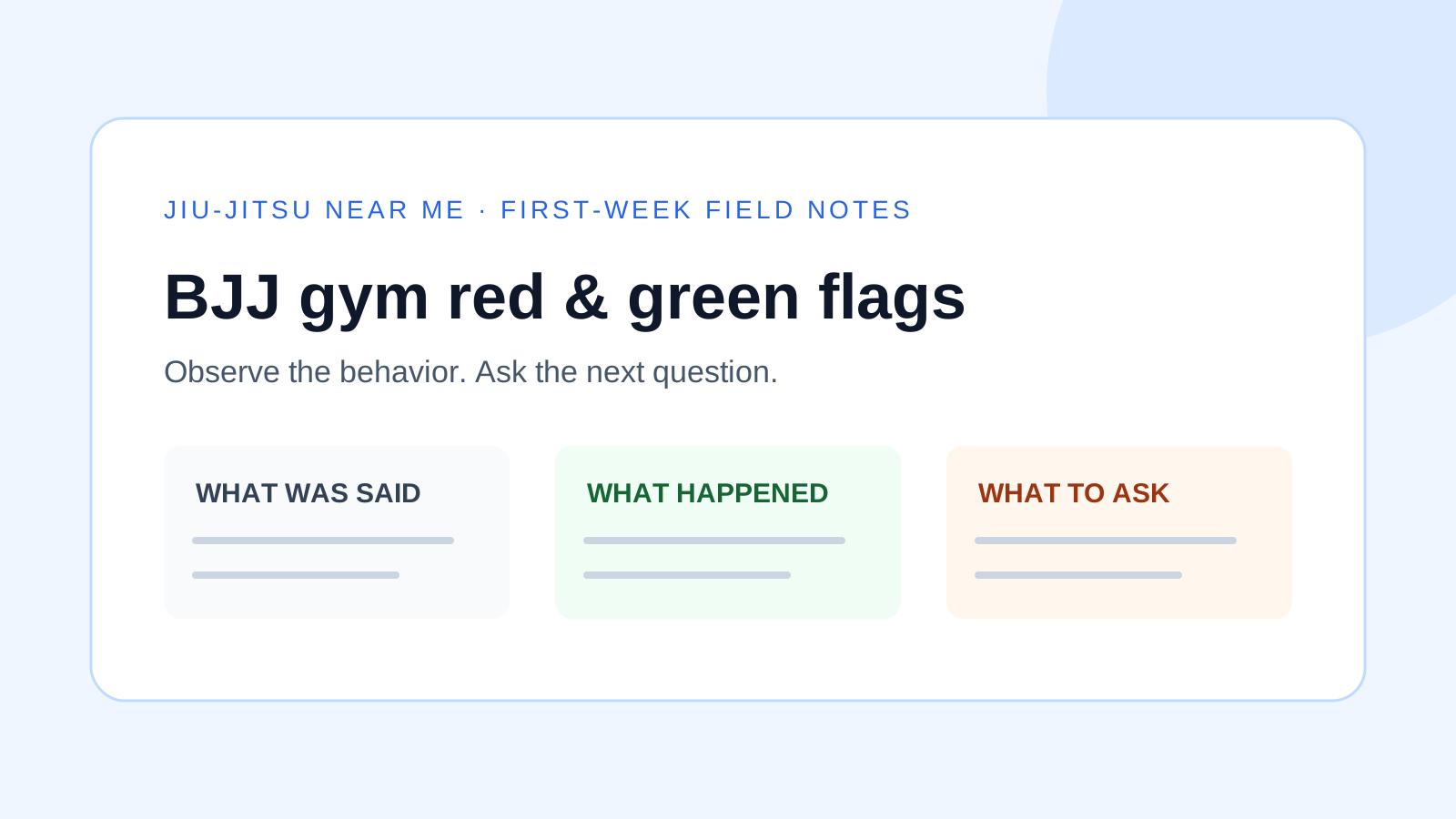
Look for what a BJJ gym does when a beginner asks a question, stops an exercise, or needs help finding a partner. Welcoming explanations, clear expectations and follow-through are useful green flags. Dismissing a stop signal, humiliating a student or repeatedly ignoring a concern deserves attention. A trial week can reveal behavior, but it cannot certify a gym's safety or prove its long-term culture.
Scope: Adults observing recreational BJJ classes. This is an educational gym-comparison tool, not medical advice, a safeguarding assessment, contract advice or a validated safety score.
Start with behavior, not a verdict about the gym
A trial class gives you a small window into a BJJ academy. Instead of deciding whether it has a good or bad atmosphere in the abstract, write down what happens when someone needs an explanation or asks to pause. You can revisit a specific interaction; a vague first impression is harder to check.
The Academy of Jiu-Jitsu's published etiquette permits polite questions during instruction and asks partners to respect taps and account for differences in size, age and strength. Those are examples of stated expectations you can ask a gym to explain, not independently verified observations of its classes. Read the academy's own policy.
Our broader gym-choice guide helps you plan questions before enrolling. This guide has a narrower job: recording whether the answers match what you observe during a trial week.
Green flags worth recording
Look for a coach who explains the exercise, identifies who can help and responds constructively when a newcomer is unsure. Notice whether someone helps you join a pair, whether you can ask about the intended pace, and whether an agreed pause is respected. These are prompts for your own observation, not a research-backed predictor of injury risk.
A useful green flag is follow-through: the coach says beginners receive an introduction, then actually gives you one. Record the action rather than a label such as “friendly.” Someone remembering your name may help you feel welcome, but it does not establish technical competence or tell you how every concern will be handled.
Published expectations can make a conversation more concrete. Tamo Junto BJJ's rules describe welcoming visitors across affiliations and releasing a submission when a tap is felt or suspected. Ask the academy you visit what its own procedures are and how it explains them to beginners. This is an example of a written policy, not an endorsement or a universal rulebook. Tamo Junto's academy rules.
Red flags that deserve a direct response
Do not dismiss an ignored stop signal or ridicule for asking to end an exercise as something you must accept to fit in. Stop participating if you are uncomfortable, explain the specific concern to the coach and decide whether you want to return. You do not need to complete a trial week to end an activity.
The coach's response gives you something else to record. Do they ask what happened, explain the next step and follow through? Or do they dismiss the concern without addressing it? Do not turn a single unclear interaction into a public accusation, but do not erase it from your notes either. For orientation on stop signals, see the tapping guide.
For cleanliness, record visible conditions and ask who handles cleaning and how students learn the rules. Do not try to diagnose a skin condition, infer infection risk from smell or treat a tidy room as a health certification. Both example academies publish expectations about clean clothing and footwear around the mat; that does not establish how effectively a particular facility is cleaned. The Academy's hygiene rules and Tamo Junto's rules.
Preferences are not automatically warning signs
Separate a poor fit for you from misconduct. A formal greeting, a competition-focused class, a quiet room or a preferred uniform color may simply be a practice you do not enjoy. Ask what is required, whether it changes between classes and whether it fits the experience you want. There is no need to make an allegation to choose another gym.
The same caution applies to the belts you see. An afternoon fundamentals class is not a record of the academy's entire membership or retention history. If you notice few experienced students, ask which sessions they usually attend rather than concluding they all left. This is a limit of your observation, not a claim about that gym's retention.
Likewise, a federation listing answers a narrower question than “Will this class suit me?” IBJJF describes academy registration in relation to athlete membership and competition entry. Use that information when it is relevant to your competition plans; it does not replace observing a class. Absence from a search result alone is not proof of bad coaching. IBJJF's registration explanation.
A first-week observation log you can reuse
Copy this structure into a note on your phone. Leave a field blank when you do not know the answer. This is our editorial worksheet, not a validated inspection or ranking system.
| Moment | Record what happened | Follow-up question |
|---|---|---|
| Before the visit | What the gym said beginners would do, who would teach and what to bring. | “Who should I find when I arrive?” |
| Joining the class | How you were introduced to the exercise and a partner. | “What should someone completely new do in this activity?” |
| Asking for help | Your question, the answer and whether the explanation resolved it. | “Could you show that again before I continue?” |
| Setting a boundary | How a request to pause, change activity or clarify the pace was handled. | “Who should I speak to if this happens again?” |
| After class | Any unanswered question and what the coach said would happen next. | “Can you clarify that before my next visit?” |
| A later visit, if you choose one | Whether the promised explanation or change actually happened. | “Is this how your regular beginner class usually works?” |
Keep the note about your own experience. You do not need other students' names, photos, medical details or private stories. Do not post a class recording to seek an online verdict about someone else.
Continue, clarify or stop: make a decision without a score
Review your notes after the trial
- Continue comparing: the class broadly matched the explanation, your questions were addressed and you want to return. Keep checking fit; this is not a safety guarantee.
- Clarify before committing: the class format, expectations or follow-up is still unclear. Ask the specific unanswered question rather than filling the gap with an assumption.
- Stop the trial: you do not want to continue, or a boundary or concern has not been addressed to your satisfaction. You do not owe the gym another session to justify your choice.
You can send a simple follow-up: “Thank you for the class. I was unsure about the activity we discussed afterward. Before another visit, could you explain what a new student should do and who I should ask for help?” Adapt it to what actually happened; do not imply an incident that did not occur.
What a trial week cannot tell you
This guide does not establish that either cited academy is better than another, that its written rules are consistently enforced, or that a visitor can certify a gym's culture in a week. It does not predict your health outcomes, assess safeguarding arrangements or interpret membership rights. The proposed log helps you distinguish an observation, a stated policy and an unanswered question; it is not an independent audit.
Use the first-class guide to prepare for the visit, then compare nearby BJJ gyms. A directory listing helps you find candidates, not verify everything about their classes.
Sources and editorial review
Not independently expert-reviewed. This guide draws on the cited sources but has not been reviewed by an independent specialist. Research and drafting were AI-assisted.
Author background: Jeremy Doromal — BJJ practitioner with 8 years of experience (author-reported). Practitioner experience is not a medical or safeguarding qualification.
A public Reddit question about red and green flags at a new gym informed the reader intent. We compared published rules from The Academy of Jiu-Jitsu and Tamo Junto BJJ, and checked IBJJF's academy-registration explanation. These are primary sources for their own stated policies, not evidence that either gym follows them in practice or represents all gyms. The observation log and decision process are original editorial synthesis; no visits, interviews, testing or independent specialist review were performed.
What this guide adds: A first-week observation log separating what a gym promises, what the visitor actually sees, the coach's response and what still needs checking; plus a non-scored continue/clarify/stop decision process.
- Etiquette
The Academy of Jiu-Jitsu · Accessed 2026-10-24
This academy permits polite questions during instruction; Its written rules address clean gear, mat footwear, tap release and partner intensity
- Tamo Junto Academy Rules
Tamo Junto Brazilian Jiu-Jitsu · Accessed 2026-10-24
This academy's published rules welcome visitors and different affiliations; Its rules cover footwear, clean uniforms and release when a tap is felt or suspected
- Academy Certification: General Info
International Brazilian Jiu-Jitsu Federation · Accessed 2026-10-24
IBJJF explains academy registration in the context of athlete membership and competition registration; A registration record does not describe an individual visitor's class experience
Find a BJJ gym near you
Search thousands of gyms across all 50 states.
Own a gym?
Claim or add your listing - free, no account required.
JD
Jeremy Doromal
Jeremy Doromal is the creator of Jiu-Jitsu Near Me. Specialist credentials and firsthand testing are disclosed only when documented for the article.
gym-selectionbeginnerstrial-classgym-culture
Related Posts

